

I describe how the system works from inside. Specific steps — verify for your state and plan.
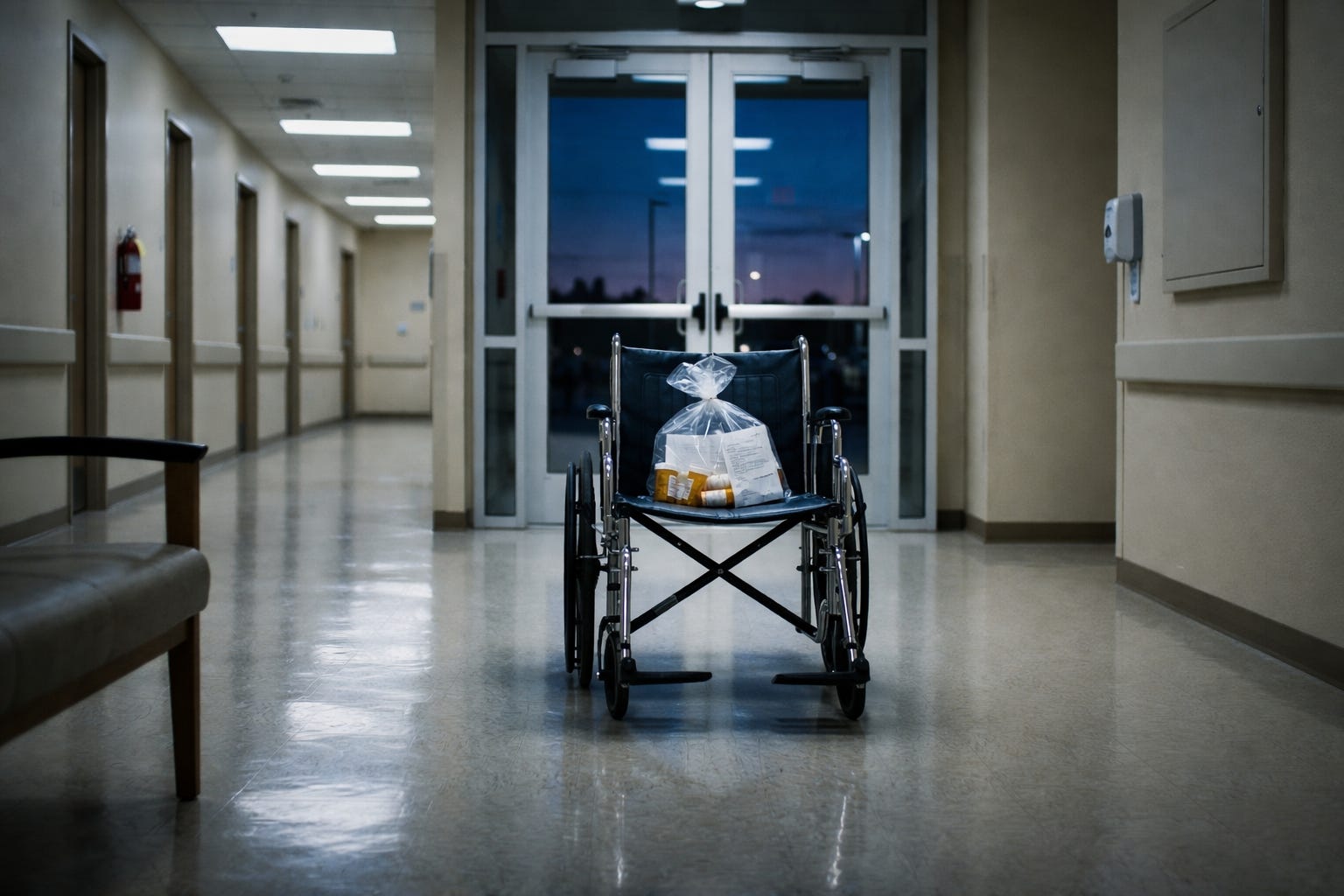
The discharge order hit the screen at 4:47 on a Friday. By 5:15, the bed was flagged for turnover. By 6, the patient’s name was off the board. The attending had already signed out to the weekend covering physician, someone who’d never seen the patient and wasn’t going to rebuild the discharge plan at 9 PM.
Transport got called before discharge teaching was done. The wheelchair arrived while the nurse was still trying to explain the new blood thinner. The teaching happened in the hallway, standing up, with the transport aide holding the elevator.
His granddaughter got the call at work. Come pick up Grandpa, they said. He’s ready.
He wasn’t ready. No prescriptions filled. No follow-up appointment. No home health referral. A new blood thinner he’d never taken before, and the pharmacy near their house closed at 6. His PCP’s office had been shut since noon. The visiting nurse agency didn’t start new cases on weekends.
Every service he needed was locked behind a two-day wall. And the discharge summary — the one document that tells his PCP what happened and what to do next. It hadn’t been dictated yet. On Friday afternoon, it wouldn’t be.
This is the Friday dump. It has a name because it happens every week.
Saturday morning, the granddaughter is on her phone in the kitchen. She’s got the discharge papers spread across the table, trying to figure out if Grandpa’s new blood thinner replaces the old one or goes on top of it. The paperwork says “continue home medications.” Which ones, it doesn’t say. The hospital pharmacy number rings to a recording. The 24-hour nurse line puts her on hold for forty minutes, then transfers her to a voicemail that’s full. She gives him the old pill and the new pill and hopes she didn’t just double him up on anticoagulants. Nobody will know until Monday whether she guessed right.

The Bed Math
Hospitals get paid a flat fee per diagnosis — the DRG. Stay three days or seven, the check is the same.
Friday is consistently the heaviest discharge day. Bed pressure, weekend staffing gaps, cross-coverage handoffs, and closed outpatient services all collide on the same afternoon. The discharge planner’s screen at 3 PM looks like a departures board at LaGuardia — every slot needs to flip green before the end of the shift. The clinical question (”Is this patient safe to leave?”) gets crowded out by the logistical one (”Is this bed free by 7?”).
Operationally, once the discharge order is in, the patient starts moving out of the hospital’s active bed flow, even if they’re still physically in the building. A man can be sitting in a wheelchair in the lobby for two hours waiting for his ride, and his bed is already reassigned upstairs. The system logged him as gone while he’s still on hospital property, holding a bag of belongings between his knees.
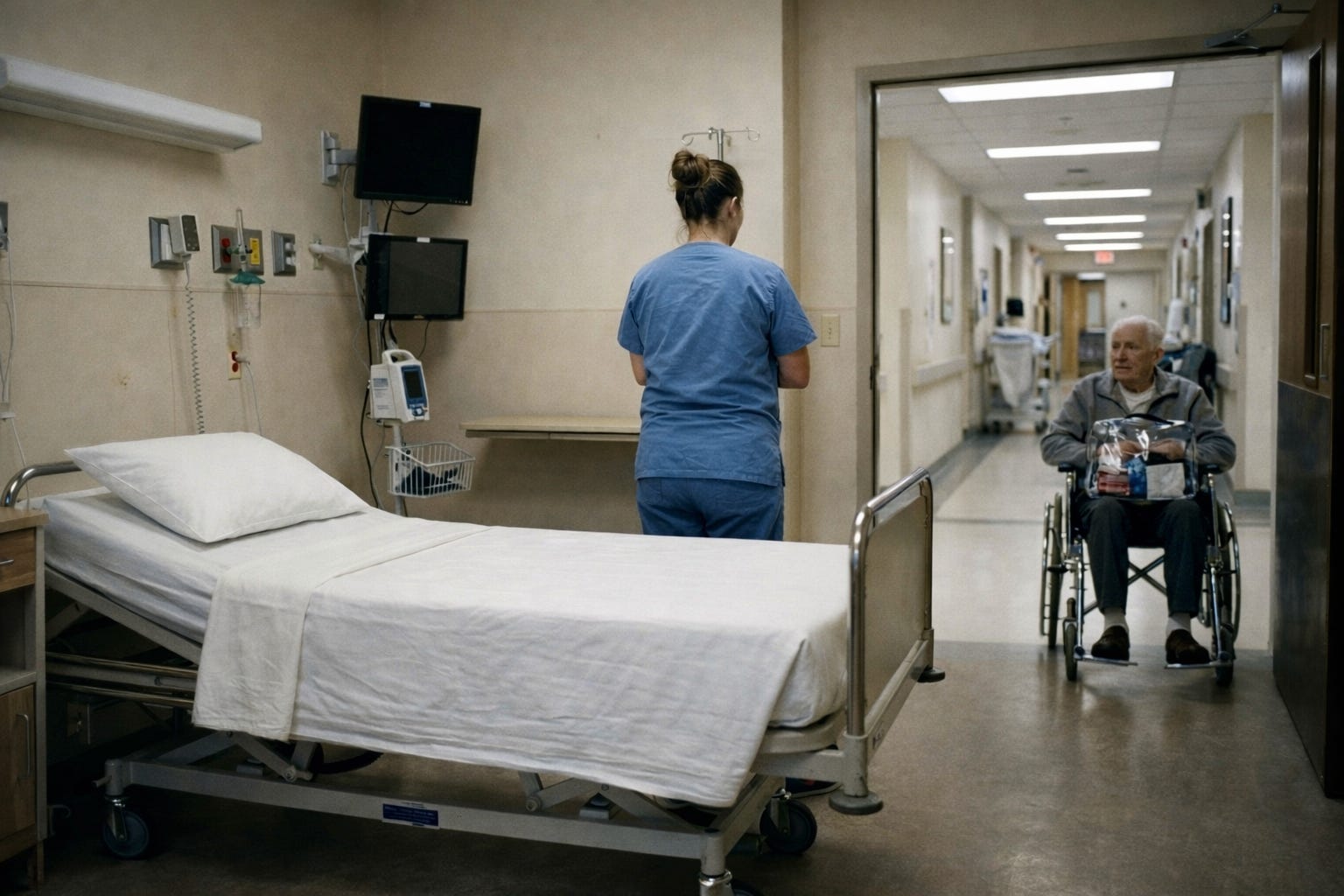
The discharge summary follows the same logic. Somewhere between 12% and 34% of those summaries ever reach the primary care provider before the patient’s first post-hospital visit (Kripalani et al., systematic review, JAMA, 2007). A third of recommended follow-up tests are never completed. The rest travel by fax, days late, to a tray nobody checks until Thursday. On Monday, primary care gets the call first and the summary second.
A study of over 2.4 million patients in Ontario found that Friday discharges carried a higher risk of death or unplanned readmission within 30 days compared to mid-week (van Walraven et al., CMAJ, 2002). The researchers pointed to two things: patients pushed out before they’re stable, and home services that can’t start until Monday.
Twenty percent of patients hit an adverse event in the first three weeks after discharge. Sixty-one percent of those events are considered preventable (Forster et al., CMAJ, 2003, 328 general medicine patients; broadly confirmed across multiple reviews cited by AHRQ Patient Safety Network). The most common problems are medication-related. A dose gets changed and nobody tells the patient, or two drugs interact and nobody caught it at reconciliation.
What It Costs When It Fails
Each bounce-back runs about $15,200 on average (HCUP/AHRQ, 2018 data). In 2018, there were 3.8 million 30-day readmissions. Total annual cost: $52.4 billion (HCUP). CMS penalizes hospitals with high readmission rates through the Hospital Readmissions Reduction Program. The system punishes the bounce-back but rewards the Friday rush that causes it. The hospital saves by discharging Friday. Then bleeds when the patient comes back Tuesday.
Somewhere in this math is a man who just got home with the wrong pills.
That granddaughter standing in the lobby with a plastic bag of unsigned papers — no power of attorney. Not on the HIPAA authorization. She can’t call the PCP and get a callback because, to the system, she doesn’t exist. She’s carrying a human being home with less information than the discharge planner who spent four minutes on the case.
But before she signs anything, she needs to understand one thing. The discharge packet is a stack of pages. The one that matters is usually buried, between the pharmacy reconciliation and the DME authorization. One sentence. The hospital is done with the bed. The family is left with the follow-up. Her signature confirms she received the paperwork. It doesn’t fix what’s missing from the plan.
The paperwork shifts responsibility downstream fast. The risk doesn’t disappear with a signature — it just changes address.
How to Stop It
Five words:
“I don’t feel safe leaving.”
Say it out loud. Then say: “I need that documented in the chart.” A spoken concern disappears with the shift change. A charted concern stays in the medical record, and the medical record is the only thing the hospital’s lawyers read.
Patient advocate. Most hospitals have someone in this role: patient relations, patient representative, or ombudsman. Ask for whoever handles patient complaints about care decisions. Say: “I want to speak with someone about this discharge. I don’t believe the plan is safe.” They can’t overrule a physician. But they can slow the process long enough for someone to actually look at what’s missing. On a Friday evening, slowing the process is the whole game.
Written discharge plan. In many states, hospitals must provide one before you leave. In New York, it’s state law: the plan has to describe arrangements for every service you’ll need post-discharge, and those services must be secured or reasonably available. If no pharmacy is open, no nurse is scheduled, and no follow-up is booked, the plan has a hole. Name the hole. Put it in writing if you can.
If the plan says “home health referral pending,” nobody has accepted the case yet. “Follow up with PCP in 7 days” is not an appointment — it’s an instruction no one has acted on.
Medicare fast appeal. If the patient has Medicare and was admitted as an inpatient, there’s a document in that stack called “An Important Message from Medicare.” It lists the phone number for Medicare’s discharge appeal reviewer for your state, the BFCC-QIO (Beneficiary and Family Centered Care Quality Improvement Organization), currently run by either Acentra Health or Commence Health. Call by midnight on the day of discharge. While the appeal is pending, the patient stays. Doesn’t pay for the extra days. A physician reviews the record. If the discharge was premature, coverage continues. If not, Medicare covers the stay until noon the next day. Federal right. Costs nothing. Most families never hear about it because the form gets buried in a stack of papers handed over while the patient is still fogged from anesthesia.
No Medicare — escalate inside. Charge nurse. Attending. Risk manager. Use the phrase “unsafe discharge” every time — not “I’m worried” or “I’m not comfortable.” “Unsafe” frames the concern as a patient safety issue, not a disagreement. It changes the tone of the conversation and what gets documented. That matters. If the risk manager isn’t available, ask the charge nurse to page the nursing supervisor. Medicaid and private insurance appeal processes vary by state and plan type, but the core holds: the hospital has discharge-planning obligations, and you have the right to challenge a discharge you believe is dangerous. Verify the specific process for your state and plan.
The Signature
Don’t let a rushed signature replace a real discharge conversation. Leave loud, not quiet. And don’t assume the attending sees the same logistics screen the case manager is working from. Pharmacy hours, nurse availability, follow-up scheduling often live in a different system.
Don’t wait until Monday to call someone. By Monday, the readmission clock has already started.
You know the words now. Say them before the elevator door closes.
Friday discharges aren’t medical decisions. They’re calendar decisions. Nobody stops them by accident.
Love how this piece makes a structural failure feel concrete, legible, and urgent. It’s especially strong in how it shows that an “unsafe discharge” is often not a single dramatic mistake, but the cumulative result of bed pressure, staffing gaps, closed outpatient services, delayed documentation, and responsibility being rapidly pushed onto families who are least equipped to absorb it. The detail about the granddaughter standing in the kitchen trying to guess whether the old and new anticoagulants should both be given is devastating precisely because it is so plausible. This specificity makes the piece feel not only emotionally powerful, but operationally credible. It also helps that you pair the indictment with practical language families can actually use, which turns the article from observation into advocacy. 
An aspect that could perhaps make the piece even stronger would be to distinguish a bit more explicitly between discharges that are unsafe because the patient is medically not ready and discharges that become unsafe because the post-discharge infrastructure is not actually in place. The essay clearly points to both, and that is part of its strength, but separating those two pathways even more sharply could help clinicians, administrators, and families see where intervention points differ: medical reassessment, medication reconciliation, home health confirmation, pharmacy access, follow-up scheduling, or documentation handoff. In other words, the moral clarity of the piece already lands; adding one more layer of systems mapping could make it even more actionable without softening its force. 
That said, it’s a deeply important and necessary piece. It refuses to let discharge be treated as the end of the story when, for many patients, that is exactly where the most dangerous gap begins. It gives families language, timing, and leverage before they are standing in that lobby with a plastic bag of papers and no plan. Thanks again!
Years ago, my 80 + yr old father, lives alone, called me on a Sunday evening to tell me he's not doing well and probably needed to go to the hospital (He was trying to wait until Monday morning to call.)
Turns out the Wednesday before, his doctor had decided to finally take care of the thin wall of his aorta. They had been monitoring for over a year and even though at the office visit I was present for a month prior where he stated we can keep monitoring, it was decided now was the time. I highly suspect that it was because one of his students needed the procedure experience.
My father didn't bother to tell me about the procedure. I'm sure it was because the doctor told him it was because it was so routine. They did have my father spend the night Wednesday and again Thursday, but then they discharged him Friday afternoon. Apparently my father hadn't really done any walking while at the hospital. When they discharged him, they wheeled him to his car. He drove home, walked a few steps, unlocked and opened his gate then collapsed. Waited until he got his strength back and knocked over a trash can so he could use it to get back on his feet. He managed to walk a few more steps towards the house, got the key in the door and collapsed again. He managed to get in the house but he really was in no shape to care for himself. I'm not sure if or what he ate in the 48 hours before he finally called me so I could take him back to the hospital. They did send him home with medications that he dutifully took.
Thank you for the good information on this. I'm currently the primary caregiver for my disabled mother in law. Our healthcare system has so many barriers to getting her good care. It's so exhausting.